A workplace step challenge works when it is opt-in, team-based and scored fairly. Run it for 2 to 4 weeks, split people into teams, rank teams by average steps per member rather than total, publish the rules before launch, and give people who can’t walk much an equal way to score, such as active minutes. Keep individual numbers inside the challenge.
This article is general information, not medical advice. If you have a health condition, are pregnant, or haven’t been active in a while, check with your doctor before starting a new walking or exercise routine.
Key takeaways
- Average per member is the only fair way to rank teams of different sizes.
- Two to four weeks is long enough to build a habit at work without people tuning out.
- Publish rules for ties, missing data and manual entries before day one.
- Make it opt-in, offer a non-step way to score, and never rank people by weight or body measures.
- A short weekly update from the organiser keeps more people active than a big prize.
In this guide
What is a workplace step challenge?
A workplace step challenge is a time-limited competition where coworkers count daily steps, usually from their phones or watches, and compete as individuals or teams on a shared leaderboard. Most run for 2 to 6 weeks. The goal is social: more movement, more conversation across teams, and a little friendly rivalry.
The health case is simple. The CDC recommends at least 150 minutes a week of moderate-intensity activity, such as brisk walking, for adults (CDC adult guidelines), and desk jobs make that hard to reach. A challenge gives people a reason to take the stairs, walk to lunch or turn a call into a walk.
How do you plan an office step challenge?
Plan it in six steps over about two weeks: get a sponsor, pick dates, choose teams, choose the metric, choose a tracker, and announce the rules. The two most common mistakes are launching without written rules and choosing a tool that needs everyone to type in numbers by hand.
- Find a sponsor. A manager who joins visibly does more for participation than any prize. Check whether your company has a wellness or health-data policy and follow it.
- Pick dates. Two to four weeks, starting on a Monday. Avoid weeks with big deadlines, public holidays or the end of a quarter.
- Form teams. Teams of 4 to 8 work well. Mixing departments is good for getting people to talk; department-versus-department is better for rivalry.
- Choose the metric. Steps are easy to understand. Active minutes are fairer for people who cycle, swim or use a wheelchair. A points system works if you want to count workouts too.
- Choose a tracker. Pick one that reads data automatically from Apple Health and Health Connect, so iPhone and Android users can take part with whatever watch they already own.
- Announce it. Share the dates, the rules and how to join a week before the start. Ask people to join early and allow health access so day one counts.
If you want ideas for themes beyond a straight step count, our list of step challenge ideas for friends, family and coworkers includes walking-meeting weeks, lunchtime loops and personal-best weeks.
How should you score teams of different sizes?
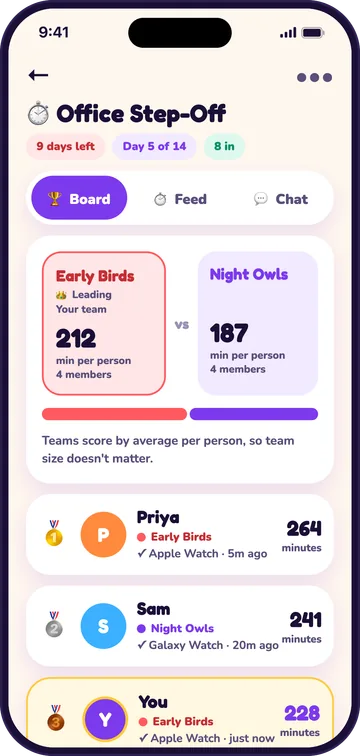
Rank teams by average steps per member, not by total. Totals reward whichever team recruited the most people, so a team of eight beats a team of five even if every member of the smaller team walks more. Averages fix that and let small departments compete with big ones.
A worked example over one week:
| Team | Members | Total steps | Average per member |
|---|---|---|---|
| Finance | 8 | 400,000 | 50,000 |
| Design | 5 | 300,000 | 60,000 |
By total, Finance wins. By average, Design wins, which matches who actually walked more. Two more scoring choices to settle up front:
- Daily caps. Some organisers cap a day at a sensible maximum so one marathon or a treadmill binge doesn’t decide the whole month. If you cap, announce the number before day one.
- Who counts in the average. Decide whether someone who joined but never synced is counted. Counting them encourages teams to nudge each other; excluding them avoids penalising a team for one inactive account.
How do you handle ties, missing data and cheating?
Decide all three before launch. Ties should share a rank unless you announced a tiebreaker in advance. Missing data needs a way to add a past day by hand, visibly marked. Cheating is rarer than organisers fear, and making manual entries visible deters most of it.
Ties
Shared places are the fairest option. If you need one winner for a prize, pick the tiebreaker in advance, such as the most days over a target, and say so in the rules.
Missing data
Phones die, watches get left on chargers, apps lose permissions after updates. Allow people to add a past day or an activity by hand during the challenge, show it as manual, and set a cut-off, such as the morning after the challenge ends, after which results lock.
Cheating
Phone-shaking gadgets exist, but most “cheating” complaints are really sync problems or watch-versus-phone double counting. Count one source per person per day, make every score traceable to the activity behind it, and keep prizes modest so there is little reason to game it.
How do you make a step challenge inclusive?
Make it voluntary, give people more than one way to score, and keep personal data personal. A step-only leaderboard can exclude coworkers with disabilities, injuries, chronic conditions or caring duties, so offer active minutes or a points format, and celebrate effort and participation as loudly as the top total.
- Opt-in only. Never tie participation to performance reviews, insurance or pay.
- No body metrics. Don’t rank weight, body fat or calories eaten. Movement is the point.
- Keep it in the group. Only participants should see the leaderboard. When you share results with the wider company, share team averages, not individual numbers.
- Several prizes. Top team, most improved, most days on target, best team name. More people have a shot.
- Remote-friendly. Count each person’s day in their own time zone so distributed teams aren’t disadvantaged.
Add a line to the announcement saying people with health conditions should check with their doctor before increasing activity, and that nobody has to share health information to take part. People who want a gentle personal plan alongside the team event can follow our 30-day walking challenge for beginners.
Sample rules you can copy
Paste these into your announcement and adjust the numbers. Clear rules in one place are the single best way to avoid disputes in week three.
- The challenge runs from Monday to Sunday four weeks later, in your own local time.
- Steps (or active minutes, if you choose that option) count automatically from your phone or watch via Apple Health or Health Connect.
- One source per day: your watch or your phone, not both added together.
- Forgot your device? Add the activity by hand by the next morning; manual entries are marked.
- Teams are ranked by average per member. Ties share the place.
- Results lock the morning after the final day.
- Joining is optional. Only people in the challenge see the leaderboard, and company-wide updates show team averages only.
Which tool should you use?
Small teams and departments do well with a consumer challenge app that syncs from Apple Health and Health Connect, scores teams by average and needs no admin work. Company-wide programmes with HR reporting, single sign-on or eligibility rules are better served by a dedicated corporate wellness platform.
Jolt Club (our app) is built for the first case: a team lead or office runs a private, invite-only challenge with one link or 6-letter code, splits it into two named teams scored by average per member, and steps, active minutes, workouts or points sync automatically, with each day finalised overnight. It has no ads and doesn’t involve money. It isn’t a corporate wellness platform, so it has no HR dashboards or company-wide admin tools. For a wider look at the options, see our fitness challenge app comparison.
Planning a challenge with friends instead? The walking challenge with friends guide is shorter and less formal.
Frequently asked questions
How long should a workplace step challenge last?
Two to four weeks is the sweet spot for most offices. One week is too short for people who join late, and six weeks or more tends to lose participants in the middle. If you want a longer programme, run several short challenges back to back with a fresh theme each time.
How big should teams be in an office step challenge?
Four to eight people per team keeps everyone accountable without anyone hiding. Teams can be uneven as long as you rank them by average per member. Let people switch teams in the first day or two, then lock them so rosters can’t be stacked.
What is a good daily step goal for a workplace challenge?
Avoid one goal for everyone. A 2022 meta-analysis found the mortality benefit of daily steps levelled off around 6,000 to 8,000 steps for adults 60 and over and 8,000 to 10,000 for younger adults (Paluch et al.). A personal target based on each person’s normal week works better.
Can remote employees join an office step challenge?
Yes. Use a tracker that reads steps from people’s own phones and watches, count each person’s day in their own time zone, and post standings in the team chat rather than on an office wall. Remote teammates often become the most active, because a walk is the easiest break at home.
Should a workplace step challenge have prizes?
Small ones help. Recognition, a team lunch, extra coffee or a trophy that rotates each challenge work better than cash, which can push people to game the numbers. Spread prizes across categories such as most improved and most days on target so more than the fittest people win.
Sources
- Centers for Disease Control and Prevention, Adult Activity: An Overview (physical activity guidelines for adults), accessed November 14, 2026.
- Paluch AE et al., Daily steps and all-cause mortality: a meta-analysis of 15 international cohorts, The Lancet Public Health, March 2022.

Jolt Club team, VirtualBeans LLC makes Jolt Club, a free app for step, walking and workout challenges with friends. We build and test the app ourselves and write these guides from what we learn running challenges. Jolt Club is our product, so we have a stake in it. Spotted an error? Email [email protected].