The best step challenge ideas match the scoring to the group. A 7-day step showdown suits friends who walk a similar amount. Two-team battles scored by average per person work for offices. Active-minutes or points challenges keep mixed-age families and gym-goers in the race. Below are 14 step challenge ideas, who each one suits, and the one rule that keeps it fair.
This article is general information, not medical advice. If you have a health condition, are pregnant, or haven’t been active in a while, check with your doctor before starting a new walking or exercise routine.
Key takeaways
- Pick the metric for the group: steps for similar walkers, active minutes for mixed ages, points for mixed sports.
- Short beats long for a first challenge: 7 days is enough to learn who is in.
- Score teams by average per member, never by total, so a team of 4 can beat a team of 6.
- Agree on what happens when a phone dies or a watch is left at home before day one.
- Research ties more steps to lower health risk only up to a point, so a fun challenge doesn’t need to chase huge numbers.
In this guide
- What are fun step challenge ideas for friends?
- Which step challenges work for families with kids and grandparents?
- What are good step challenge ideas for coworkers?
- How do you pick the right challenge for your group?
- How many steps should a step challenge aim for?
- Rules that keep any step challenge fair
- FAQ
What are fun step challenge ideas for friends?
For a group of 3 to 10 friends, the most reliable formats are a short head-to-head step race, a two-team battle, and a points challenge that counts runs and gym sessions alongside walks. Each one is easy to explain in a group chat, which matters more than any prize.
1. The 7-day step showdown
Everyone’s daily steps add up over one week and the highest total wins. It is the simplest format there is, and a week is long enough for a comeback but short enough that nobody drifts off. Start it on a Monday so the weekend lands in the middle, where it creates drama instead of deciding the result on the last day.
2. The weekend sprint
A three-day challenge from Friday to Sunday. It works for friends who are busy during the week and like a quick burst of competition. Plan one shared walk on Saturday so the challenge also becomes an excuse to see each other.
3. Two-team battle with silly team names
Split into two teams and let each pick a name. Team challenges change the mood: the person at the bottom of the leaderboard is suddenly helping their team instead of losing alone. Score by average steps per member so a team that is one person short still has a fair shot.
4. The “every move counts” points challenge
If your group includes a runner, a lifter and someone who mostly walks the dog, steps alone will crown the same person every time. Give points per activity instead, for example 2 for a run, 2 for a gym session, 1 for a walk and 1 for every full 10,000-step day. Points let different sports compete on the same board.
5. The minimum-day streak
Instead of the most steps, count the most days everyone hits a floor, such as 5,000 steps or 20 active minutes. It rewards showing up, so a friend who walks 6,000 steps every day can beat the one who does 25,000 on Saturday and nothing else.
6. The route race
Pick a route your group knows, such as the drive between two of your hometowns, and add up everyone’s walking and running distance until you “arrive”. It is a shared goal rather than a ranking, which suits groups where one person would otherwise win every week.
Which step challenges work for families with kids and grandparents?
Family challenges work best when the scoring evens out age and fitness gaps. Active minutes, minimum-day streaks and family-versus-family team battles all do this, because a grandparent walking 30 minutes a day can match a teenager who spends hours on a phone.
7. Generations challenge (active minutes)
Score active minutes rather than steps. Kids rack up steps fast, so a step count can feel unwinnable for an older relative, while minutes of movement are closer to even. A 14-day challenge suits this: long enough for a routine, short enough to stay fun.
8. Cousins versus cousins
Two branches of the family each form a team. It gives relatives in different cities a reason to message each other every day, and it is a gentle way for a family to be competitive without anyone being singled out.
9. The after-dinner walk week
For one week, the household counts steps taken on a walk after the evening meal. It is less about winning than about building one shared habit, and it is a good first challenge for younger kids.
10. The holiday step challenge
Run a custom-length challenge across a holiday week or the stretch between two holidays. It keeps a family connected while people travel, and it gives everyone a reason to suggest a walk after a big meal.
What are good step challenge ideas for coworkers?
Workplace step challenges work best as team events: department battles scored per person, walking-meeting weeks and lunchtime loops. They keep the focus on doing something together rather than ranking individual bodies, which matters when colleagues have very different health and schedules.
11. Department battle
Each department or office is a team, scored by average per member. Announce the standings every Monday. If teams are very different sizes, averages are the only fair option. Our guide to running a workplace step challenge covers rules, ties and inclusion in detail.
12. Walking-meeting week
For one week, any one-on-one that does not need a screen happens on foot. Track the team’s combined steps and see how much the week moves the total compared with a normal one.
13. The lunchtime loop
Map a 15 or 20-minute loop from the office and count the days each person walks it. Remote teammates can pick their own loop. It is a minimum-day challenge in disguise, and it tends to be the format people keep doing after the challenge ends.
14. Personal-best week
Everyone records an ordinary week first, then tries to beat their own average by the biggest percentage the following week. A beginner can win this one, which makes it a good choice for teams with a few very active people. Most apps rank raw totals, so you may need a shared spreadsheet for the final maths.
How do you pick the right challenge for your group?
Choose the metric first, then the length. Steps suit groups who mostly walk, active minutes suit mixed ages and abilities, and points suit mixed sports. For length, 7 days is a safe first challenge, 14 days builds a routine, and 30 days is for groups that already enjoyed a shorter one.
| Your group | Best metric | Good first length |
|---|---|---|
| Friends who all walk a similar amount | Steps | 7 days |
| Runners, cyclists and walkers together | Distance or points | 14 days |
| Gym crew plus non-lifters | Workouts or points | 14 days |
| Kids, parents and grandparents | Active minutes | 14 days |
| Office with uneven teams | Steps, team average per member | 2 to 4 weeks |
| People just starting out | Minimum-day streak | 30 days |
If you’re starting from scratch, our step-by-step guide to a walking challenge with friends covers invites, rules and keeping people engaged after day three.
How many steps should a step challenge aim for?
A friendly challenge doesn’t need extreme totals. A 2022 meta-analysis of 15 studies in The Lancet Public Health found that more daily steps were linked to lower risk of death, with the benefit levelling off at about 6,000 to 8,000 steps a day for adults 60 and older and 8,000 to 10,000 for younger adults.
That study, led by Amanda Paluch, pooled data from nearly 50,000 adults, and its authors note that the famous 10,000-step goal began as a pedometer marketing campaign rather than as a scientific target (Paluch et al., 2022; UMass Amherst summary). The CDC’s guideline for adults is 150 minutes a week of moderate activity such as brisk walking (CDC).
So for a group, a target around each person’s current average plus a little is more motivating than an arbitrary big number. If you want a gradual plan, our 30-day walking challenge builds up week by week from your own starting point.
Rules that keep any step challenge fair
Four rules settle almost every argument: agree on one source of truth, decide how missed syncs and forgotten watches are handled, score teams by average, and decide in advance that ties stay ties. Write them in the group chat on day one.
- One source per person per day. Count either the phone or the watch, not both, so nobody is counted twice.
- Forgot your watch? Allow people to add an activity or a past day by hand, and let the group see that it was added manually.
- Late syncs. Decide when a day is final. Waiting until the next morning stops “I synced at midnight” disputes.
- Ties. Share the rank. Breaking a tie by who joined first or alphabetical order feels arbitrary to the person who loses.
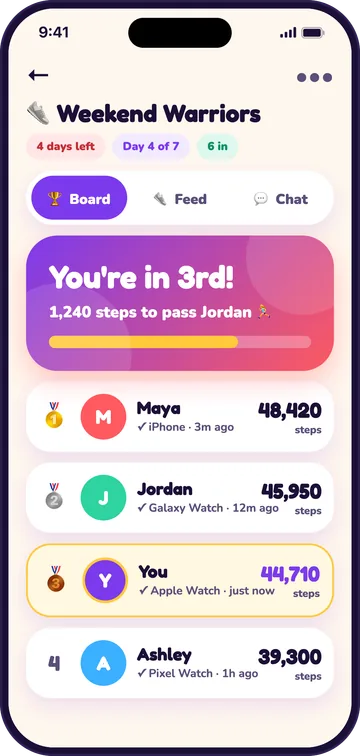
We built Jolt Club (our app) around these rules. Steps and workouts sync automatically from Apple Health or Health Connect, each day is finalised overnight so a day counts even if someone never opens the app, manual entries are marked, and ties are shown as ties. It supports steps, active minutes, distance, workouts, gym days, active calories and custom points, solo or in two named teams. If you’d rather compare options first, here is our honest look at fitness challenge apps.
Frequently asked questions
What is a good step challenge for beginners?
A minimum-day streak is the kindest format for beginners. Pick a floor such as 5,000 steps or 20 active minutes and count the days each person reaches it. Nobody is outpaced by a marathon runner, and the habit matters more than the total. Run it for 14 or 30 days.
How long should a step challenge last?
Seven days is the best length for a first challenge because people stay interested and the result arrives quickly. Fourteen days is long enough to build a routine. Save 30-day challenges for groups that already enjoyed a shorter one, or plan check-ins every week so the middle doesn’t sag.
How do you make a step challenge fair for people with different fitness levels?
Change what you score. Active minutes, minimum-day streaks and personal-best weeks all reward effort rather than raw totals. For teams, use the average per member. You can also run two boards at once: one for total steps and one for the most days on target.
Can kids join a family step challenge?
Yes, and kids often love the leaderboard. Keep it playful: active minutes or a shared family goal work better than ranking a child against adults on steps. If kids use their own devices, check the app’s age requirements and keep the challenge private to family members.
What prizes work for a step challenge?
Small, social prizes work best: the winner picks the next restaurant, the losing team cooks dinner, or the champion holds a silly trophy until the next challenge. Bragging rights and a share card in the group chat often motivate more than money, and they keep the challenge friendly.
Sources
- Paluch AE et al., Daily steps and all-cause mortality: a meta-analysis of 15 international cohorts, The Lancet Public Health, March 2022.
- University of Massachusetts Amherst, Meta-analysis of 15 studies reports new findings on how many daily walking steps are needed, March 2, 2022.
- Centers for Disease Control and Prevention, Adult Activity: An Overview (physical activity guidelines for adults), accessed November 14, 2026.

Jolt Club team, VirtualBeans LLC makes Jolt Club, a free app for step, walking and workout challenges with friends. We build and test the app ourselves and write these guides from what we learn running challenges. Jolt Club is our product, so we have a stake in it. Spotted an error? Email [email protected].