A 30-day walking challenge for beginners starts with one extra 10-minute walk a day and builds to 30 minutes of brisk walking on five days a week by week four. That final week adds up to 150 minutes, the weekly amount of moderate activity the CDC recommends for adults. The plan below has easy days built in, a step-count version, and tips for doing it with friends.
This article is general information, not medical advice. If you have a health condition, are pregnant, or haven’t been active in a while, check with your doctor before starting a new walking or exercise routine.
Key takeaways
- Week 1: add a 10-minute walk every day. Week 4: 30 minutes on five days.
- Five 30-minute brisk walks a week equals the CDC’s 150-minute weekly guideline for adults.
- “Brisk” means you can talk but not sing, according to the CDC’s talk test.
- If you prefer steps, start from your own three-day average, not from 10,000.
- Two easy days a week keep the plan doable; missing a day doesn’t mean starting over.
In this guide
What does a 30-day walking challenge look like?
This 30-day walking challenge is a four-week ramp from 10 minutes a day to 30 minutes on five days a week, plus a two-day finish. Walks get longer each week and slightly brisker from week three. Every week has easy days, so your legs, feet and schedule get a breather.
| Days | Walk days | Each walk | Easy days | About per week |
|---|---|---|---|---|
| 1–7 | Every day | 10 min, comfortable pace | None needed | 70 min |
| 8–14 | 5 days | 15 min, comfortable pace | 2 (gentle stroll or rest) | 75 min |
| 15–21 | 5 days | 20–25 min, last 5 min brisk | 2 | 100–125 min |
| 22–28 | 5 days | 30 min, brisk | 2 | 150 min |
| 29–30 | 2 days | Your favourite route, any length | Celebrate | – |
The week-four target matches the CDC’s adult guideline of 150 minutes of moderate-intensity activity, such as brisk walking, every week, which it suggests can be split as 30 minutes on five days (CDC adult guidelines).
How do you start if you haven’t walked much lately?
Start where you are, not where the plan says. If 10 minutes feels like a lot, walk 5 minutes twice a day for the first week and repeat any week that felt hard. Comfortable shoes, a route you like and a fixed time of day matter more than pace at the start.
Pick the time first: after breakfast, at lunch, or after dinner. Tying the walk to something you already do every day is the easiest way to remember it. Keep the first week truly easy; the goal is to show up seven days in a row, not to get tired.
If you have a heart, lung or joint condition, are pregnant, or haven’t exercised in a long time, talk to your doctor before you start, and stop and get help if you feel chest pain, faintness or unusual shortness of breath.
The plan, week by week
Each week changes one thing: first the habit, then the time, then the pace. Changing one variable at a time is what keeps the plan beginner friendly, and it makes it easy to tell what to repeat if a week felt too hard.
Week 1 (days 1–7): build the habit
Walk 10 minutes every day at a pace that feels easy. Same time, same route if that helps. On day 7, note how you feel and whether the time of day worked. If it didn’t, move it for week two.
Week 2 (days 8–14): add time
Walk 15 minutes on five days. On the other two, take a gentle stroll or rest. Try one new route this week; a change of scenery keeps it interesting.
Week 3 (days 15–21): add pace
Walk 20 to 25 minutes on five days, and make the last five minutes brisk. Use the CDC’s talk test: at moderate intensity you can talk, but not sing (CDC, measuring intensity). If you can sing, speed up a little. If you can’t speak in full sentences, slow down.
Week 4 (days 22–28): 30 brisk minutes
Walk 30 minutes at a brisk pace on five days. You can split a day into two 15-minute walks if your schedule is tight. By the end of this week you have walked about 150 minutes, the weekly amount the CDC recommends.
Days 29–30: celebrate and decide
Walk your favourite route, maybe with someone else, and look back at week one. Then pick what comes next, so the habit doesn’t stop with the challenge.
How many steps should you aim for?
Aim to beat your own starting average rather than a fixed number. Walk normally for three days, add up the steps your phone or watch recorded, divide by three, and use that as your baseline. Adding the walks in this plan will raise it week by week.
If you want a reference point, a 2022 meta-analysis of 15 studies in The Lancet Public Health found that more steps a day were associated with lower risk of death, levelling off at about 6,000 to 8,000 steps for adults aged 60 and over and 8,000 to 10,000 for younger adults (Paluch et al., 2022). The researchers found no clear extra link with walking speed beyond the total number of steps (UMass Amherst summary). That is an association across large groups, not a personal prescription, and the biggest drop in risk in that study came between the least active quarter of people and the next quarter up.
A step-based version of this plan:
- Week 1: your baseline plus about 1,000 steps a day.
- Week 2: baseline plus 1,500 on five days.
- Week 3: baseline plus 2,000 to 2,500 on five days.
- Week 4: baseline plus 3,000 on five days.
What if you miss a day?
Skip it and carry on with the next day of the plan. One missed day in 30 makes no real difference, but quitting over it does. If you miss three or more days in a row, repeat the previous week instead of jumping ahead.
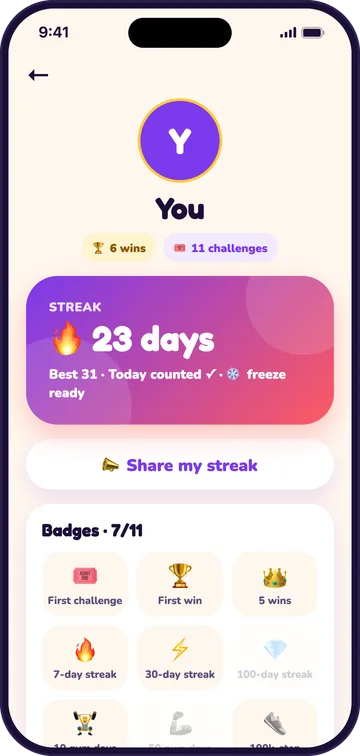
Many people find a streak with a built-in “freeze” helpful: one missed day a week doesn’t break the run. It keeps the pressure low while still rewarding consistency. If life gets busy, a 10-minute walk still counts as a walk day.
Is a 30-day walking challenge easier with friends?
For most people, yes. A friend expecting you at 7 am, or a leaderboard where you can see them inching ahead, is a stronger reminder than any calendar alert. You can do the plan together, each from your own baseline, and compare days on target rather than raw totals.
Two ways to set it up:
- A shared streak. Everyone tries to walk on as many days as possible, and the group cheers each other on.
- A friendly race. A 30-day active-minutes challenge, where each person’s walking minutes add up on one board. Minutes are fairer than steps for mixed groups.
Not sure which app to use? Here’s how the main fitness challenge apps compare.
Our guide to starting a walking challenge with friends covers invites and rules. In Jolt Club, our app, you can run this as a 30-day steps or active-minutes challenge: walks sync from Apple Health or Health Connect, a day counts even if you never open the app, you can add a past day by hand, and your streak gets one automatic freeze each week. A streak day counts with 5,000 steps, 20 active minutes or a 10-minute workout, so even an easy day can keep it going.
What should you do after day 30?
Keep the five weekly walks and change one thing for the next month: a longer weekend walk, a hillier route, or a new challenge with friends. The CDC also recommends muscle-strengthening activity on two or more days a week, so adding two short strength sessions is a sensible next step.
If you liked the competition, our list of step challenge ideas has 14 formats to try next, from weekend sprints to two-team battles. Running something at work? See the workplace step challenge guide.
Frequently asked questions
Is a 30-day walking challenge good for beginners?
Yes, if it starts small. This plan begins with 10 minutes a day and only reaches 30 brisk minutes in week four, with two easy days a week from week two. Repeat any week that feels too hard. If you have a health condition or haven’t been active for a long time, check with your doctor first.
How far is a 30-minute walk?
It depends on your pace, height and the terrain, so the honest answer is that it varies from person to person. Use your phone or watch to check the distance on your usual route during week one. The plan is based on time rather than distance, so you don’t need to know it to follow along.
Will a 30-day walking challenge help me lose weight?
We can’t promise any particular result, and a walking plan isn’t a weight-loss programme. Regular walking counts towards the CDC’s activity guideline, and many people enjoy better energy and routine from it. For weight goals, talk to your doctor or a registered dietitian about a plan that fits you.
Can I do the 30-day walking challenge on a treadmill?
Yes. Treadmill walks count the same as outdoor ones for this plan. Use the talk test to judge “brisk”, and most phones and watches will still record the time or steps. A small incline can add variety in week four if the flat setting feels easy.
Do I have to walk every day?
No. Only week one asks for every day, because it builds the habit with short walks. From week two you walk on five days and keep two easy days. Choose them to fit your week, and move them around if you need to.
Sources
- Centers for Disease Control and Prevention, Adult Activity: An Overview (physical activity guidelines for adults), accessed November 14, 2026.
- Centers for Disease Control and Prevention, How to Measure Physical Activity Intensity, accessed November 14, 2026.
- Paluch AE et al., Daily steps and all-cause mortality: a meta-analysis of 15 international cohorts, The Lancet Public Health, March 2022.
- University of Massachusetts Amherst, Meta-analysis of 15 studies reports new findings on how many daily walking steps are needed, March 2, 2022.

Jolt Club team, VirtualBeans LLC makes Jolt Club, a free app for step, walking and workout challenges with friends. We build and test the app ourselves and write these guides from what we learn running challenges. Jolt Club is our product, so we have a stake in it. Spotted an error? Email [email protected].